
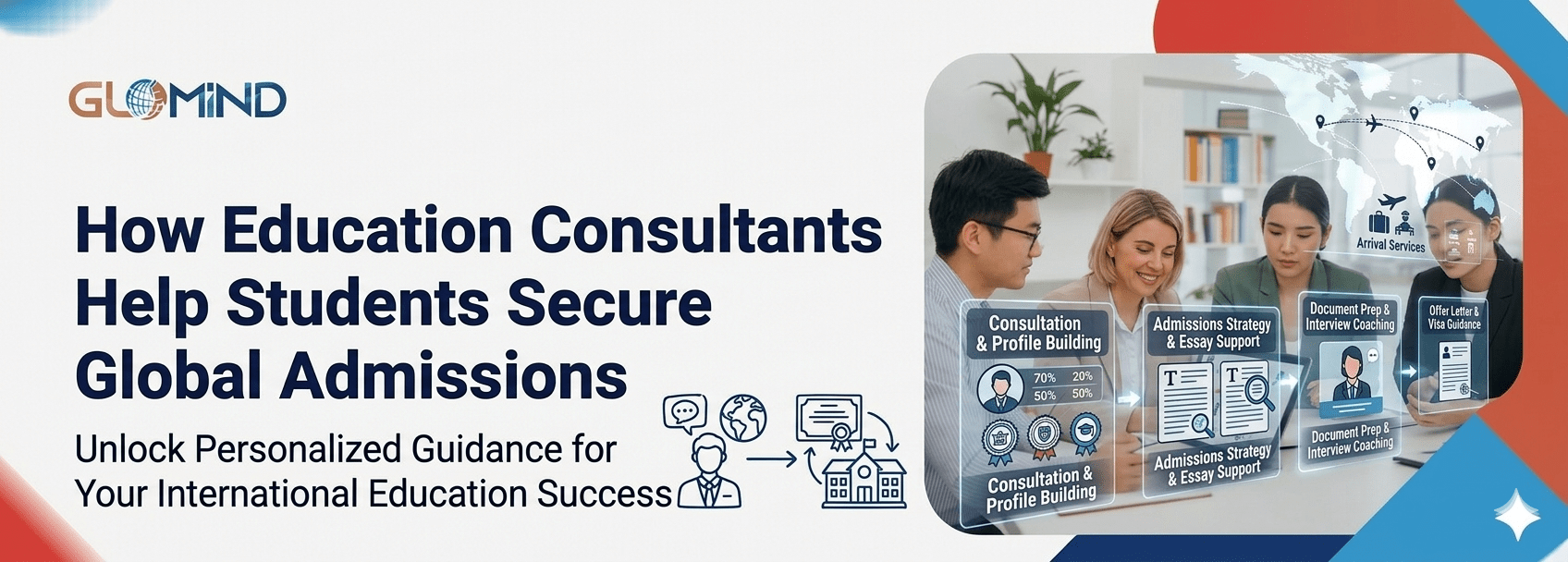
Key Highlights
- International admissions become easier when students follow a clear process instead of handling course selection, applications, finances, and visa work separately.
- A step-by-step approach helps families compare destinations, intakes, documentation, and total study costs more realistically.
- Visa success depends heavily on timely paperwork, financial clarity, and interview readiness.
- Estimated study costs should include tuition, living expenses, tests, visa fees, insurance, and travel, not just university fees.
- Personalized counseling adds value by aligning academic goals, budget, and country options in one roadmap.
Table of Contents
- Introduction
- About Us
- What should students do before starting international admissions?
- How does the admission process move step by step?
- What makes visa support so important?
- How should students estimate their total study costs?
- Conclusion
- FAQs
Introduction:
Planning to study abroad is exciting, but it can also feel confusing when everything seems urgent at once. At Glomind Overseas, the Top Overseas Consultancy in Hyderabad where students often begin with broad questions like which country to choose, which course has better value, how much the total expense will be, and what documents are needed for admission and visa approval. Without a proper sequence, the process becomes stressful. Students may shortlist the wrong universities, miss deadlines, underestimate budgets, or prepare weak documentation. That is why a step-by-step plan matters. It turns a complicated dream into an organized process with clear milestones.
About Us:
At Glomind Overseas, we simplify the study abroad journey with step-by-step support from admission to arrival. We assist students with course selection, university applications, SOPs, LORs, visa processing, and cost estimation, including tuition and living expenses. Our personalized approach ensures that students and parents feel supported at every stage. With expert guidance and a smooth process, we help turn global education dreams into well-planned and achievable goals.
What should students do before starting international admissions?
The first step is not filling out forms. It is understanding the student profile properly. A student needs clarity on academic interests, preferred destination, budget comfort, intake timeline, and long-term goals before any application begins.
A strong planning stage usually includes:
- profile evaluation based on marks, background, and goals
- course and country matching
- shortlist creation based on budget and eligibility
- test planning for IELTS, TOEFL, PTE, or Duolingo where required
- timeline mapping for intake, applications, and visa stages
Admission preparation snapshot
| Stage | What happens here | Why it matters |
| Profile review | Academic and career assessment | Prevents random shortlisting |
| Course selection | Compares suitable programs | Improves fit and outcomes |
| University shortlist | Filters realistic options | Saves time and cost |
| Document prep | SOP, LOR, CV, transcripts | Strengthens application quality |
| Financial planning | Tuition + living cost estimate | Avoids budget surprises |
| Visa prep | Documents and interview support | Reduces rejection risk |
Suggested image placement: a simple flowchart showing “Profile Review → Shortlist → Documents → Applications → Offer → Visa → Departure”.
How does the admission process move step by step?
Once the planning stage is complete, students can move through the admission cycle with better confidence. This stage needs accuracy because even small errors in documentation or university selection can affect the outcome.
How does shortlisting work?
Shortlisting is more than choosing famous universities. It involves comparing course structure, eligibility, tuition, intake availability, scholarships, and future opportunities. The consultancy’s site states that it provides expert help with shortlisting top universities across major study destinations and supports students in choosing the right course, country, and career path.
What documents are usually prepared?
Documentation is one of the most important parts of the process. This typically includes:
- academic transcripts
- passport and identification documents
- statement of purpose
- letters of recommendation
- updated resume or CV
- English test scores
- financial documents where needed
The consultancy specifically mentions support for SOPs, LORs, resumes, and admission-ready applications, which is useful because these elements often influence admit quality.
What happens after applications are submitted?
After submission, students usually track responses, evaluate offer letters, understand conditions, and decide whether to accept an offer. This is also the stage where tuition deposits, scholarship opportunities, and accommodation planning may begin. A guided process helps students avoid panic decisions and compare offers more carefully.
What makes visa support so important?
Many students focus strongly on admission and then underestimate the visa stage. In reality, the visa process demands just as much preparation, especially around financial clarity, document accuracy, and interview readiness. The consultancy states that it offers step-by-step support for student visa documentation and interview preparation.
Key visa support areas
- checking visa-specific document lists
- preparing proof of funds and financial records
- organizing offer letters and enrollment documents
- reviewing travel and insurance readiness
- preparing for visa interviews where applicable
- avoiding mistakes in timelines and submission formats
Why does this stage need expertise?
- Visa requirements differ by country.
- Financial documents must be consistent and credible.
- Students often need guidance on confidence, interview communication, and compliance.
- A missed requirement can delay or damage the whole plan.
Suggested image placement: a checklist-style visual for “Offer Letter, Passport, Financial Proof, Visa Forms, Interview Prep”.
How should students estimate their total study costs?
One of the biggest mistakes students make is comparing only tuition fees. Real budgeting should include every major expense linked to studying abroad. The consultancy’s website says it offers scholarship and financial-aid advisory along with budget planning and study-abroad expense guidance, which directly supports cost planning.
Estimated study cost table
| Cost Component | What to include |
| Tuition fees | Annual or semester-based fees |
| Test expenses | IELTS, TOEFL, PTE, Duolingo coaching and exam fees |
| Application charges | University application fees |
| Visa costs | Visa fee and processing-related expenses |
| Living expenses | Rent, food, transport, utilities |
| Insurance | Mandatory health cover where applicable |
| Travel | Flight and initial relocation cost |
| Buffer fund | Emergency or settlement reserve |
Why should students estimate early?
- It helps compare countries more honestly.
- It supports better scholarship planning.
- It prepares families for hidden expenses.
- It prevents last-minute financial stress.
Conclusion:
A successful study-abroad journey is rarely built on guesswork. It comes from following the right sequence: understanding the student profile, choosing suitable courses and countries, preparing strong applications, organizing visa paperwork carefully, and planning the full cost of education in advance. When these steps are handled in the right order, the journey becomes clearer, safer, and more manageable. That is the real value of professional counseling in international admissions.
FAQs:
1. How does Glomind Overseas support students better than handling admissions alone?
Glomind Overseas brings multiple stages together, including counseling, university shortlisting, documentation, visa guidance, and cost planning, instead of leaving students to manage each part separately.
2. Why is Glomind Overseas useful during visa preparation as well as admissions?
Glomind Overseas states that it supports both admission readiness and step-by-step visa documentation and interview preparation, which helps students stay organized through the full process.
3. Can Glomind Overseas help compare countries based on total study cost?
Yes. Its services include scholarship and financial-aid advisory plus budget planning, which helps students look beyond tuition alone.
4. Does Glomind Overseas only help with applications, or also with settling abroad?
It also mentions pre- and post-arrival support, including travel, stay, cultural preparation, and settling into student life.
5. How does Glomind Overseas make documentation easier for students?
It provides support for SOPs, LORs, resumes, and application-ready documentation, which can improve accuracy and presentation.
6. Why do students consider Glomind Overseas when looking for guided international admission support?
Because its service structure covers the main pain points students face: course selection, university guidance, finances, English tests, visa processing, and arrival support.
