
Key Highlights
- Learn how to evaluate international universities beyond rankings
- Understand the link between course selection, career outcomes, and affordability
- Discover key factors like tuition fees, scholarships, employability, location, and ROI
- Know how expert counselling can help students make smarter global education decisions
- Get a practical checklist to compare universities before applying
Table of Contents
- Introduction
- About Us
- Why Should Students Look Beyond University Rankings?
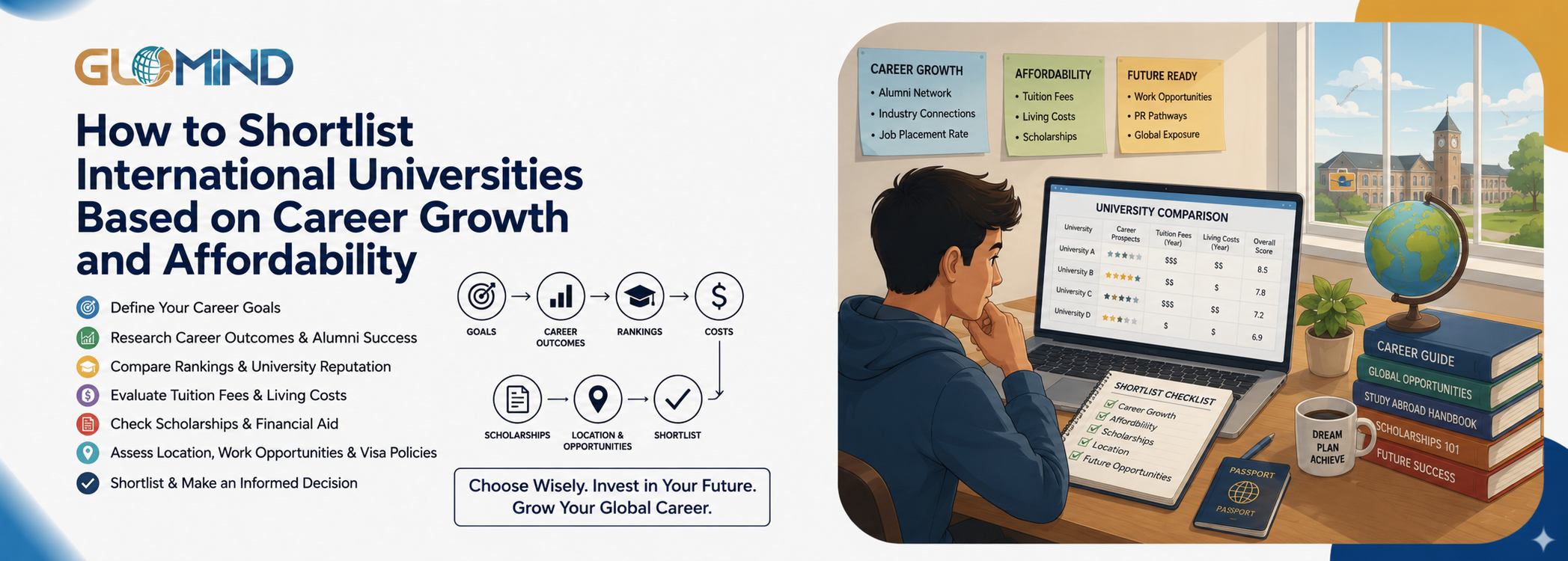
- How Can Career Growth Influence University Shortlisting?
- How Should Students Compare Affordability Before Applying?
- What Role Do Scholarships and Part-Time Work Opportunities Play?
- University Shortlisting Comparison Table
- Practical Checklist for Students
- Conclusion
- FAQs
Introduction:
Choosing an international university is one of the most important decisions in a student’s academic journey. At Glomind Overseas, the Top Overseas Consultantancy in Hyderabad where it is not only about selecting a popular destination or a highly ranked institution; it is about finding the right balance between career growth, affordability, academic quality, and long-term opportunities. Many students get attracted to big university names without checking whether the course matches their career goals, whether the total cost is manageable, or whether the country offers strong post-study work options. This is where smart shortlisting becomes essential.
About Us:
At Glomind Overseas, students receive personalized guidance to shortlist international universities based on career opportunities, affordability, and long-term goals. The consultancy offers expert counseling, IELTS/PTE coaching, scholarship assistance, and visa support for countries like the USA, UK, Canada, Australia, and Ireland. Interactive career seminars, student success webinars, language training sessions, and pre-departure events help students gain confidence for global education journeys.
Why Should Students Look Beyond University Rankings?
University rankings can be helpful, but they should not be the only deciding factor. A university may rank high globally, but it may not always be the best fit for a student’s chosen course, budget, or career plan.
Students should evaluate rankings along with practical factors such as:
- Course relevance
- Faculty expertise
- Industry connections
- Internship exposure
- Placement support
- Alumni success
- Location-based job opportunities
- Tuition fees and living expenses
For example, a university with a slightly lower global ranking may offer stronger industry tie-ups, better internships, and more affordable tuition for a specific field. This can provide better value than choosing a university only because of its brand name.
How Can Career Growth Influence University Shortlisting?
Career growth should be one of the biggest factors while selecting an international university. Students must ask whether the chosen course can lead to strong employment opportunities in the destination country or globally.
Career-focused factors to check:
| Factor | Why It Matters |
| Graduate Employability | Shows how successful students are after completing the course |
| Internship Opportunities | Helps students gain real-world exposure |
| Industry Partnerships | Connects students with employers |
| Post-Study Work Visa | Gives time to find jobs after graduation |
| Alumni Network | Helps in mentorship and professional growth |
| Course Curriculum | Ensures skills match market demand |
Students should also check whether the course includes practical learning, live projects, research opportunities, or professional certifications. These elements can make a student’s profile stronger for future job opportunities.
How Should Students Compare Affordability Before Applying?
Affordability is not just about tuition fees. Students must calculate the complete cost of education, including accommodation, food, transport, health insurance, visa fees, travel costs, and personal expenses.
Cost factors students should compare:
- Annual tuition fee
- Living expenses in the city
- Accommodation options
- Health insurance cost
- Travel expenses
- Application and visa fees
- Currency exchange impact
- Availability of scholarships
A university with lower tuition but located in an expensive city may become costlier overall. On the other hand, a university with slightly higher tuition but strong scholarships and affordable living conditions may offer better financial value.
What Role Do Scholarships and Part-Time Work Opportunities Play?
Scholarships can significantly reduce the financial burden of studying abroad. Many universities offer merit-based, need-based, country-specific, and course-specific scholarships. Students should research these options before finalizing their shortlist.
Common scholarship types:
- Merit-based scholarships
- Academic excellence awards
- Early application scholarships
- Diversity scholarships
- Course-specific grants
- Government-funded scholarships
Part-time work opportunities also help students manage living expenses and gain professional exposure. However, students should not depend entirely on part-time income to fund their education. It should be considered as support, not the main source of funding.
University Shortlisting Comparison Table
| Shortlisting Criteria | Questions Students Should Ask |
| Course Quality | Does the curriculum match my career goal? |
| Career Outcomes | What are the placement and employability rates? |
| Affordability | Can I manage tuition and living costs comfortably? |
| Scholarships | Does the university offer financial aid? |
| Location | Is the city good for jobs in my field? |
| Visa Benefits | Are post-study work options available? |
| Student Support | Does the university help international students? |
| ROI | Will the degree justify the total investment? |
This comparison helps students shortlist universities with clarity instead of confusion.
Practical Checklist for Students
Before finalizing international universities, students should review the following points:
- Check if the course aligns with long-term career goals
- Compare tuition fees and living expenses together
- Review post-study work visa rules
- Research job opportunities in the chosen country
- Study university employability reports
- Check internship and placement support
- Explore scholarship options before deadlines
- Understand admission eligibility requirements
- Compare 5–8 universities before final selection
- Take expert guidance for application and visa planning
This approach helps students create a balanced shortlist that supports both career growth and affordability.
Conclusion:
Shortlisting international universities requires careful planning, research, and financial awareness. Students should not select universities only because of popularity or rankings. Instead, they should focus on career outcomes, affordability, scholarships, visa benefits, industry exposure, and return on investment.
A strong university shortlist gives students better admission chances, reduces financial stress, and helps them move closer to their professional goals. With the right guidance, students can choose universities that are not only academically strong but also practical, affordable, and career-focused.
FAQs:
- How does Glomind Overseas help shortlist international universities?
Glomind Overseas compares universities based on career goals, budget, course quality, and future opportunities. - Does Glomind Overseas focus only on university rankings?
No, Glomind Overseas considers affordability, employability, scholarships, location, and long-term ROI. - Can Glomind Overseas help students find affordable universities?
Yes, Glomind Overseas suggests options that balance quality education with manageable expenses. - How does Glomind Overseas support career-focused course selection?
Glomind Overseas guides students toward programs aligned with industry demand and professional growth. - Does Glomind Overseas help compare scholarships?
Yes, Glomind Overseas helps students explore university scholarships and financial aid options. - Why trust Glomind Overseas for university shortlisting?
Glomind Overseas offers personalized counselling to help students make practical global education choices.
