
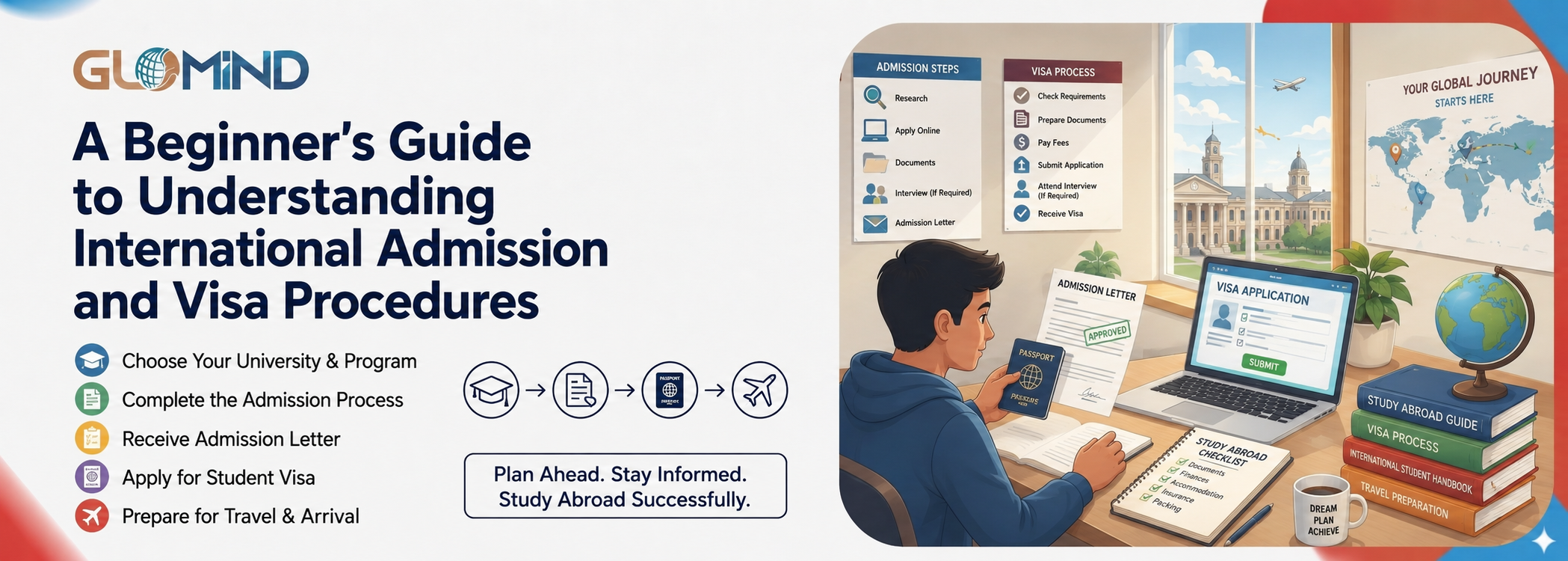
Key Highlights
- Understand the basic steps involved in international university admissions
- Learn how visa procedures work after receiving an offer letter
- Know which documents students should prepare before applying
- Discover how counselling, timelines, and financial planning reduce application stress
- Get a simple admission-to-visa roadmap for first-time applicants
- Build a trusted study abroad plan with expert guidance
Table of Contents
- Introduction
- About Us
- Why Should Beginners Understand the Admission and Visa Process Early?
- How Does the International Admission Process Work?
- What Documents Are Required for Admission and Visa Applications?
- How Does the Student Visa Process Work?
- What Common Mistakes Should Applicants Avoid?
- Admission and Visa Process Timeline
- Conclusion
- FAQs
Introduction:
Studying abroad is a major life decision that brings together academic ambition, career planning, financial readiness, and personal growth. At Glomind Overseas, the best overseas education consultants in hyderabad where for beginners, the international admission and visa process may seem confusing because it involves multiple steps, including course selection, university applications, entrance tests, documentation, offer letters, fee payments, visa filing, and interview preparation. Without proper understanding, students may feel overwhelmed or miss important deadlines that can affect their admission chances.
About Us:
Glomind Overseas supports students in building a clear, confident, and well-planned international education journey. From profile evaluation and university shortlisting to application filing, documentation, visa guidance, interview preparation, and pre-departure support, the team helps students understand every step with clarity. With personalized counselling and destination-specific expertise, Glomind Overseas assists aspiring learners in making informed decisions for a successful academic future abroad.
Why Should Beginners Understand the Admission and Visa Process Early?
International admissions are time-sensitive. Every university and country follows specific deadlines, eligibility rules, documentation standards, and visa requirements. Students who begin early have more time to shortlist suitable programs, prepare for tests, improve their profiles, and arrange finances.
Early understanding helps students:
- Avoid missed admission deadlines
- Prepare accurate academic and financial documents
- Apply for scholarships on time
- Improve English proficiency or entrance test scores
- Reduce visa rejection risks
- Make informed decisions about destination and course
- Plan accommodation, travel, and pre-departure steps smoothly
For first-time applicants, the biggest advantage of early planning is confidence. When students know the process, they can focus better on choosing the right academic path instead of feeling stressed by paperwork.
How Does the International Admission Process Work?
The admission process usually begins with career counselling and course selection. Students should first identify their interests, academic background, future goals, and preferred countries. After this, they can shortlist universities that match their budget, eligibility, and career expectations.
Common Admission Steps
| Step | What It Includes |
| Profile Evaluation | Academic scores, career goals, budget, preferred destination |
| Course Shortlisting | Choosing programs based on interest and employability |
| University Selection | Comparing rankings, fees, scholarships, and outcomes |
| Test Preparation | IELTS, TOEFL, PTE, GRE, GMAT, SAT, if required |
| Application Submission | Uploading forms, documents, SOP, LORs, and resume |
| Offer Letter | Receiving conditional or unconditional admission |
| Fee Payment | Paying deposit or tuition as per university requirement |
Students should remember that every country may have a slightly different process. Some universities accept direct applications, while others may need additional tests, interviews, or portfolio submissions.
What Documents Are Required for Admission and Visa Applications?
Documents are the foundation of both admission and visa success. Incomplete or incorrect paperwork can delay applications or create unnecessary complications.
Admission Documents
- Passport
- Class 10 and 12 mark sheets
- Graduation transcripts, if applicable
- Degree or provisional certificate
- Statement of Purpose
- Letters of Recommendation
- Resume or CV
- English proficiency test score
- Entrance exam score, if required
- Portfolio for creative courses
Visa Documents
- Valid passport
- University offer letter
- Confirmation of enrollment or CAS, if applicable
- Financial proof
- Bank statements
- Education loan letter, if applicable
- Affidavit of support
- Medical documents, where required
- Visa application form
- Passport-size photographs
- Travel insurance, if required
Document Readiness Checklist
| Document Type | Recommended Preparation Time |
| Passport | 12 months before intake |
| Academic Records | 10–12 months before intake |
| Test Scores | 8–10 months before intake |
| SOP and LORs | 6–8 months before intake |
| Financial Documents | 4–6 months before intake |
| Visa File | 2–4 months before intake |
Preparing these documents early allows students to correct errors, arrange missing papers, and submit applications confidently.
How Does the Student Visa Process Work?
A student visa allows an applicant to legally study in another country. The visa process usually begins after receiving an admission offer from a recognized institution. Students must prove that they are genuine applicants, financially capable, academically eligible, and willing to follow immigration rules.
Basic Visa Process
- Accept the university offer
- Pay the required deposit or tuition fee
- Receive enrollment confirmation
- Arrange financial documents
- Complete visa application form
- Pay visa fee
- Attend biometric appointment, if required
- Appear for visa interview, if applicable
- Wait for visa decision
Visa requirements differ by country. For example, some destinations may ask for proof of funds for tuition and living expenses, while others may also require health insurance, medical tests, or immigration interviews.
What Common Mistakes Should Applicants Avoid?
Many beginners make mistakes because they are unaware of how detailed the process can be. Avoiding these errors can improve admission and visa success.
Common Mistakes
- Choosing a course without career clarity
- Applying only to highly competitive universities
- Submitting generic SOPs
- Missing scholarship deadlines
- Uploading unclear scanned documents
- Providing inconsistent information
- Arranging financial documents too late
- Ignoring visa interview preparation
- Depending on unofficial information
- Waiting until the last moment to apply
A trusted counsellor can help students review every step carefully and avoid errors that may affect their future plans.
Conclusion:
International admission and visa procedures may seem complicated at first, but they become easier when students understand the process step by step. The key is to start early, stay organized, prepare accurate documents, and follow deadlines carefully. A beginner should never treat admission and visa planning as separate tasks because both are connected.
With the right guidance, students can avoid confusion, reduce stress, and improve their chances of studying at the right international institution. A planned approach makes the study abroad journey smoother, more reliable, and more successful.
FAQs:
- How does Glomind Overseas help beginners with study abroad admissions?
Glomind Overseas explains every step, from course selection to university applications and visa filing. - Does Glomind Overseas support first-time applicants?
Yes, Glomind Overseas helps beginners understand documents, deadlines, admission rules, and visa processes. - Can Glomind Overseas help with visa documentation?
Glomind Overseas assists with financial proof, forms, offer letters, and visa file preparation. - Does Glomind Overseas guide students for visa interviews?
Yes, Glomind Overseas prepares students with interview guidance and country-specific visa support. - How does Glomind Overseas simplify admission procedures?
Glomind Overseas provides personalized counselling, application support, and step-by-step process clarity. - Why choose Glomind Overseas for admission and visa guidance?
Glomind Overseas makes the complete study abroad process more organized, reliable, and beginner-friendly.
